Free Public Transport
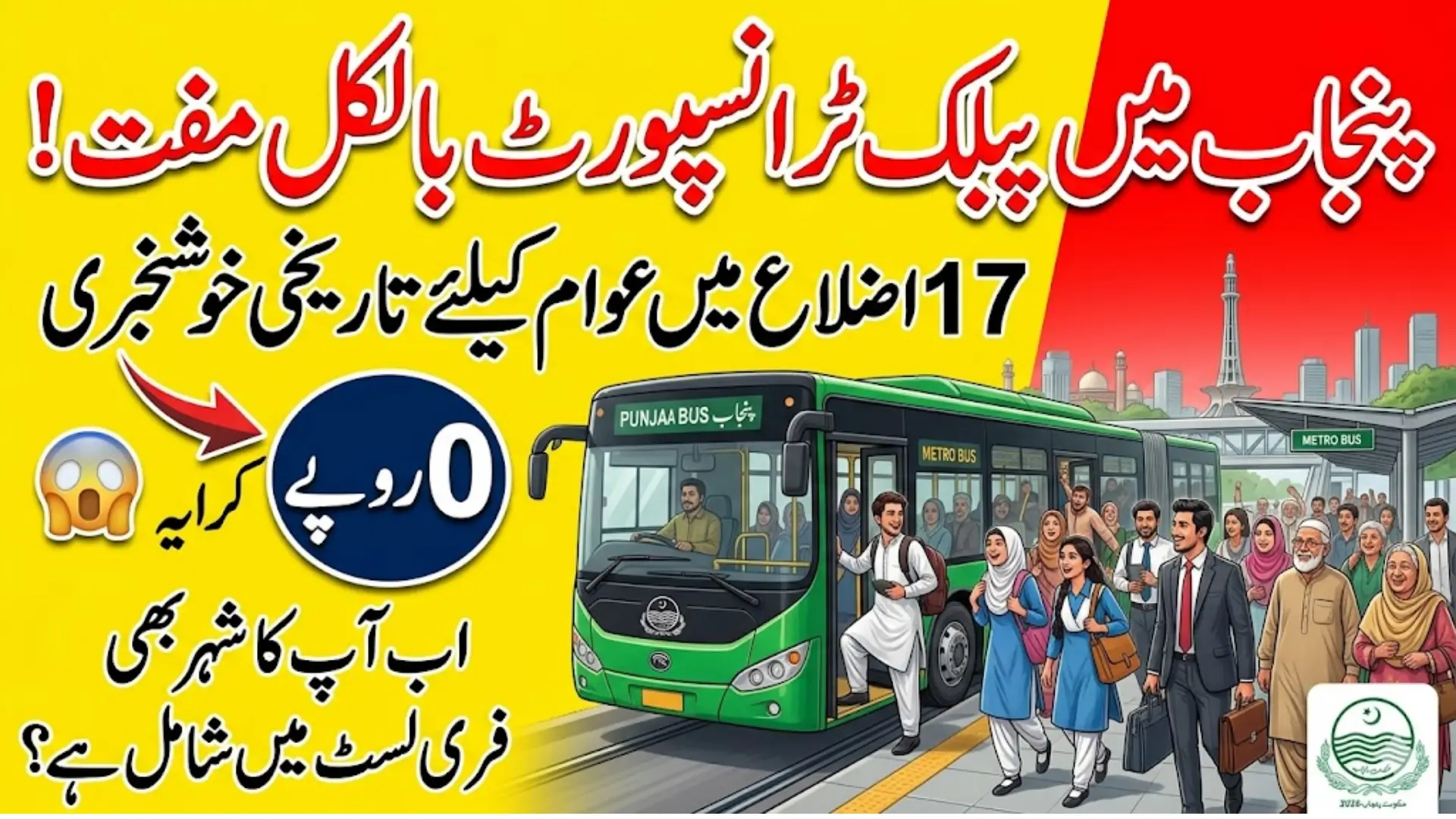
Free Public Transport Punjab government has officially moved towards a major public relief initiative by expanding free public transport across 17 districts in 2026. This decision is being seen as one of the most important transport-related policy changes in recent times, especially at a moment when fuel prices and daily commuting costs continue to rise in Pakistan. For ordinary citizens, especially students, office workers, and low-income families, transport expenses have become a serious monthly burden.
From what is being reported after the official meeting chaired by Chief Minister Maryam Nawaz, the government is actively working on a structured plan to make travel more affordable and accessible. Instead of limiting free transport only to big cities, the focus is now shifting towards a broader provincial coverage. This expansion shows a clear policy direction aimed at reducing financial pressure on commuters in both urban and semi-urban districts.
At the ground level, this move is expected to directly impact thousands of daily passengers who depend on buses and metro services. The initiative also reflects a growing trend in Pakistan where governments are using transport subsidies as a tool to provide economic relief during inflation.
Official Decision Announced by Punjab Government Leadership
The announcement of free public transport in 17 districts was made after a detailed high-level meeting chaired by Chief Minister Maryam Nawaz. In this meeting, senior officials reviewed transport operations, fare systems, and the impact of recent fuel price changes on the general public. The main focus remained on how to reduce the burden on citizens who are struggling with rising living costs.
Authorities were also directed to prepare a detailed report within 24 hours regarding per-kilometer transport fares. This urgent instruction shows that the government is not treating this as a long-term theoretical plan but rather as a fast-moving policy that requires immediate implementation. The leadership is clearly pushing departments to speed up decision-making and execution.
This approach also highlights that the government wants to ensure transparency and proper financial planning before expanding the scheme further across Punjab.
District-Wise Expansion Plan and Pilot Project Cities
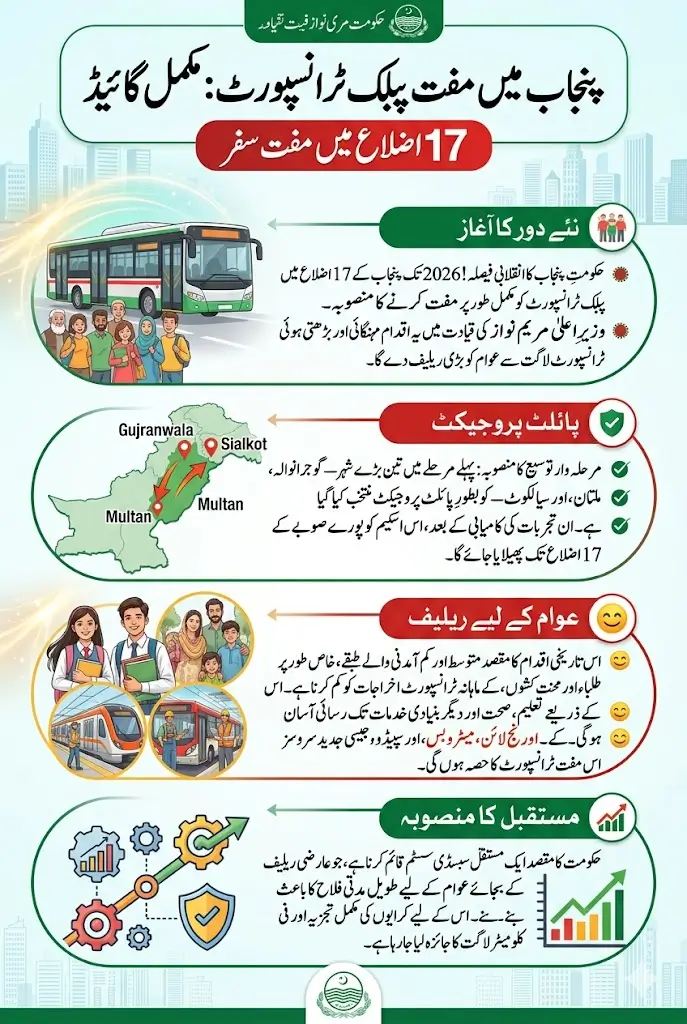
The new transport relief plan includes 17 districts in Punjab, although the complete official list is expected to be released gradually. For now, the government has confirmed pilot implementation in three major cities, which will act as testing grounds before full-scale rollout across the province.
These pilot districts have been selected strategically to represent different travel patterns, population densities, and urban transport challenges. This will help authorities understand how free transport systems behave under real pressure conditions.
Pilot Project Cities and Focus Areas:
- Gujranwala (Urban + industrial passenger load testing)
- Multan (Large city commuter flow analysis)
- Sialkot (Mixed urban and business travel patterns)
- Remaining districts will be added after evaluation phase
The idea behind this phased expansion is to ensure that the system does not collapse under sudden demand. By starting small and then scaling up, the government aims to identify operational gaps and fix them before nationwide implementation.
Existing Free Transport Services in Punjab Already Active
Before this new expansion, the Punjab government had already introduced free travel on several major public transport systems in key cities. These earlier measures played an important role in shaping the current policy direction and public expectations.
In cities like Lahore and other urban centers, passengers are already benefiting from modern transport systems that operate with government subsidies. These services have helped reduce daily travel costs and improved mobility for thousands of commuters.
Currently Available Free Transport Services in Punjab:
- Orange Line Metro Train
- Metro Bus Service Lahore and other routes
- Speedo Bus Network in selected areas
- Green Electric Bus Services
These services were initially introduced as part of urban transport development projects. However, with rising fuel prices, they have now become an important part of public relief strategy.
Fare Analysis, Fuel Prices and Government Planning Strategy
One of the most important parts of this new initiative is the detailed analysis of transport fares based on fuel price fluctuations. The government has asked relevant departments to calculate per-kilometer transport costs and submit a comprehensive report within a very short deadline. This indicates that policy decisions will be based on real data rather than assumptions.
Fuel price changes in Pakistan have a direct impact on transport fares, which eventually affects daily commuters. When diesel and petrol prices increase, transport operators are forced to adjust fares, making travel more expensive for ordinary citizens. The Punjab government is now trying to stabilize this situation through subsidies and free travel models.
Government Planning Focus Areas:
- Detailed per-kilometer fare calculations
- Impact analysis of fuel price fluctuations
- Budget allocation for transport subsidies
- Long-term sustainability framework
- Service quality and passenger demand management
Transport Fare Review Overview
| Analysis Area | Purpose of Review |
|---|---|
| Fuel Cost Impact | Understand fare pressure on citizens |
| Per KM Calculation | Ensure fair pricing model |
| Passenger Demand Study | Estimate service load |
| Subsidy Planning | Manage government funding |
This structured analysis will decide how the free transport system will be expanded in the coming months.
Comparison With Islamabad Free Transport Relief Model
A similar relief measure was previously introduced in Islamabad, where public transport was made free for 30 days after a sharp increase in fuel prices. That decision was temporary in nature and mainly focused on immediate relief during inflation pressure.
In comparison, Punjab’s approach appears more long-term and structured. Instead of a short-term relief window, the government is planning a phased expansion across multiple districts. This suggests that Punjab is aiming to build a more permanent public transport subsidy system rather than temporary relief campaigns.
This difference is important because it shows how provincial policies can evolve from short-term support into long-term infrastructure-based welfare programs.
Public Impact and Real Benefits for Daily Commuters
For common citizens, especially those living in middle and lower-income households, this initiative can bring significant financial relief. Daily commuting costs in Pakistan have increased over the past few years, and many families now spend a large portion of their income just on transport.
Students traveling to colleges and universities, workers going to factories or offices, and patients visiting hospitals will benefit the most from this scheme. Free public transport can reduce pressure on household budgets and improve access to essential services.
Key Benefits for Citizens:
- Reduction in monthly transport expenses
- Improved access to education and healthcare
- Easier movement across cities and districts
- Increased use of public transport systems
- Reduced traffic load on private vehicles
This initiative also encourages people to shift from private motorcycles and cars to public transport, which may help reduce traffic congestion in major cities.
Operational Challenges and Implementation Concerns
Although the plan is highly beneficial, there are practical challenges that must be addressed for successful implementation. Managing a large-scale free transport system requires strong coordination between departments, financial planning, and efficient monitoring systems.
If passenger demand increases suddenly, transport services may face overcrowding issues. Similarly, maintaining service quality without increasing operational costs will be a major challenge for authorities.
Key Implementation Challenges:
- High passenger load management
- Sustainable government funding
- Maintaining service quality standards
- Expanding transport infrastructure capacity
- Preventing misuse and system pressure
Without proper planning, even a good policy can face operational difficulties. That is why the pilot phase is extremely important for testing real-world performance.
Future Outlook of Free Transport Expansion in Punjab
At this stage, the government is still in the early phase of implementation, and more details are expected in upcoming announcements. Once pilot projects are completed, the scheme is likely to expand step by step into additional districts across Punjab.
If successfully executed, this initiative could become one of the largest public transport relief programs in the province’s history. It may also serve as a model for other provinces looking to reduce transport costs for citizens during economic pressure periods.
For now, citizens are advised to stay updated with official announcements as the rollout progresses. The coming months will determine how effectively this policy transforms daily commuting in Punjab.



Conclusion
The expansion of free public transport in 17 districts of Punjab in 2026 marks a significant shift in public policy. It reflects a clear focus on reducing the financial burden of transportation for ordinary citizens and improving mobility across the province.
While challenges remain in implementation, the structured approach with pilot projects and fare analysis shows that the government is trying to build a sustainable system. If managed properly, this initiative could bring long-term relief and reshape the public transport landscape in Punjab in a positive way