

Govt Eyes Huge Relief for Salaried
Govt Eyes Huge Relief for Salaried federal government is preparing the FY27 budget with a clear shift in direction—from strict revenue collection toward economic growth, investment, and relief for citizens. Over the past few months, economic pressure, rising inflation, and slow business activity have created serious concerns among both the public and private sectors. Now, the upcoming budget is being seen as a turning point where the government may try to rebuild confidence.
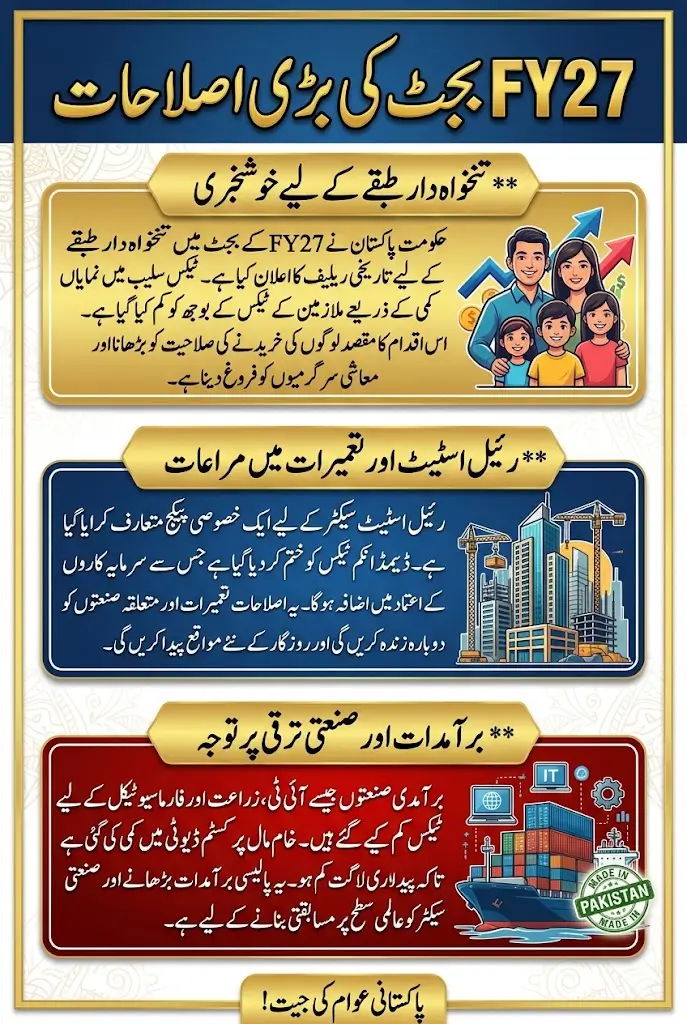
From discussions with policymakers and insights coming from financial circles, it is evident that the government wants to create a balance between fiscal discipline and economic expansion. The focus is not just on numbers, but on real-life impact—how much relief reaches a salaried employee, how easily a small business can survive, and how quickly industries can grow.

- Growth-focused budget strategy instead of tax-heavy approach
- Relief for common citizens and working class
- Strong emphasis on investment and exports
- Policy shift aimed at long-term economic stability
Relief Measures Planned for Salaried Individuals
For the salaried class in Pakistan, the last few years have been particularly challenging. With inflation rising rapidly and salaries not increasing at the same pace, many households have struggled to manage their expenses. On top of that, high income taxes have reduced take-home salaries, leaving little room for savings.
This time, the government appears to be taking a more practical approach. Proposed changes in tax slabs and rates are expected to provide meaningful relief, especially for middle-income groups. By reducing the tax burden, the government aims to increase disposable income, which can ultimately boost consumption and economic activity across the country.

The relief is not just financial—it also carries psychological importance. When people feel financially secure, they are more likely to spend, invest, and contribute positively to the economy. This is why tax relief for salaried individuals is being considered one of the most important components of the FY27 budget.
- Revision of income tax slabs to benefit middle-income earners
- Reduction in overall tax burden on salaried class
- Improved household purchasing power
- Positive impact on consumer spending and market activity
Major Changes Expected in Real Estate Sector
The real estate sector has always played a key role in Pakistan’s economy, but in recent years, it has faced uncertainty due to strict regulations and heavy taxation. Many investors moved away from property, resulting in reduced activity and slower growth.

Now, the government is planning a comprehensive real estate stimulus package to revive the sector. One of the most important proposals is the removal of tax on deemed or fictitious income, which has been widely criticized by investors. Its removal could encourage people to reinvest in property and bring back lost confidence.
In addition, reforms are expected to improve transparency and documentation within the sector. This will not only attract local investors but also encourage overseas Pakistanis to invest in real estate projects, creating new opportunities and generating employment.
- Introduction of real estate stimulus measures
- Removal of deemed income tax to boost investor confidence
- Increased transparency in property transactions
- Revival of construction and allied industries
Super Tax Reduction or Possible Elimination
One of the biggest concerns for businesses in Pakistan has been the super tax. Initially introduced as a temporary measure, it has continued to put pressure on large industries and corporations. Many business leaders have repeatedly called for its reduction or removal.
In recent discussions, Finance Minister Muhammad Aurangzeb has indicated that the government is seriously considering either abolishing or significantly reducing this tax. This move could bring immediate relief to businesses and improve their financial capacity to invest and expand operations.
Reducing the super tax is not just about easing financial pressure—it is about sending a strong message to investors that Pakistan is ready to support business growth. Lower taxes can lead to higher investment, more production, and ultimately, job creation.
- Possible abolition or reduction of super tax
- Relief for large-scale industries and corporations
- Improved investment climate in the country
- Increased chances of business expansion and job creation
Focus on Export Growth and Industrial Development
Exports are crucial for Pakistan’s economic survival, as they bring in valuable foreign exchange and reduce dependence on imports. Recognizing this importance, the government is expected to introduce targeted incentives to promote export growth in the FY27 budget.
Industries such as IT, pharmaceuticals, agriculture, minerals, and mining are likely to receive special attention. Tax reductions, financial support, and policy reforms can help these sectors compete in international markets and increase their export volumes.
At the same time, the government is also focusing on industrial development by reducing the cost of production. This includes potential tax cuts on raw materials and machinery, which can help local manufacturers produce goods at competitive prices.
- Reduction in tax rates for export-oriented industries
- Incentives for increasing export volumes
- Support for key sectors like IT and agriculture
- Measures to reduce cost of production for industries
Support Package for Small and Medium Enterprises (SMEs)
Small and Medium Enterprises (SMEs) form the backbone of Pakistan’s economy, providing employment to millions of people. However, these businesses often face challenges such as limited access to finance, complex regulations, and high compliance costs.
The upcoming budget is expected to address these issues by introducing policies that make it easier for SMEs to operate and grow. Simplified regulations, easier loan access, and reduced paperwork can significantly improve the business environment for small entrepreneurs.
Supporting SMEs is not just about helping businesses—it is about strengthening the entire economy. When small businesses grow, they create jobs, increase production, and contribute to overall economic development.
- Easier access to financing and bank loans
- Simplified regulatory framework for SMEs
- Reduction in compliance and documentation requirements
- Encouragement for startups and small businesses
Encouraging Overseas Pakistani Investment
Overseas Pakistanis have always been a major source of financial support through remittances. Now, the government wants to channel this financial strength into investment opportunities that can directly benefit the economy.
New incentives are expected to encourage overseas Pakistanis to invest in sectors such as real estate, industry, and technology. By offering attractive policies and secure investment options, the government aims to increase foreign inflows and reduce reliance on external loans.
This approach not only strengthens the economy but also builds trust among overseas Pakistanis, making them active participants in national development.
- Incentives for overseas investment in key sectors
- Increased inflow of foreign currency into Pakistan
- Reduced dependence on foreign borrowing
- Strengthening investor confidence among overseas Pakistanis
Proposed Tax Reforms and Legal Amendments
The government is also planning significant reforms in the tax system to make it simpler, more transparent, and more efficient. One of the key areas under discussion is the possible revision or rollback of Section 7E, which has been a point of concern for many taxpayers.
In addition to legal amendments, the government is focusing on digitalizing the tax system. This can reduce corruption, improve transparency, and make it easier for taxpayers to comply with regulations.
These reforms are essential for building a fair tax system that encourages compliance while reducing unnecessary pressure on individuals and businesses.
- Possible revision or removal of Section 7E
- Simplification of income tax laws
- Digitalization of tax system for transparency
- Improved compliance and reduced corruption
Liquidity Support and Ease of Doing Business
Liquidity issues have been a major problem for businesses in Pakistan, especially due to delayed tax refunds and strict financial regulations. These challenges often limit the ability of businesses to operate smoothly and invest in growth.
The government is expected to introduce measures that ensure timely refunds and flexible tax adjustment systems. This will help businesses maintain healthy cash flow and focus on expansion rather than survival.
Improving ease of doing business is also a priority. By reducing regulatory hurdles and simplifying procedures, the government can attract both local and foreign investors.





- Timely processing of tax refunds
- Flexible tax adjustment mechanisms
- Reduction in regulatory barriers
- Improved ease of doing business environment
Key Expected Relief Measures in FY27 Budget
| Sector | Expected Relief | Impact on Economy |
|---|---|---|
| Salaried Class | Tax cuts, revised slabs | Higher purchasing power |
| Real Estate | Stimulus package, tax relief | Increased investment |
| Businesses | Super tax reduction | Expansion and job creation |
| Export Sector | Lower taxes, incentives | Growth in exports |
| SMEs | Easy financing, simple rules | More employment |
| Overseas Investment | Attractive policies | Increased foreign inflows |
Conclusion: A Budget Aimed at Stability and Growth
The FY27 budget is shaping up to be one of the most important financial plans in recent years. Instead of focusing only on revenue collection, the government is trying to create a balance between relief and growth. This approach reflects an understanding of the real challenges faced by citizens and businesses.
If these proposed measures are implemented effectively, they can bring meaningful change. Salaried individuals may finally feel some financial relief, businesses could expand with confidence, and key sectors like exports and real estate may see renewed growth. In the end, the success of this budget will depend not just on announcements, but on how well these policies are executed on the ground.